Feeling Overwhelmed by Fitness and Nutrition? Start Small. Start Here.
I get it. You want to make a change.
You’re motivated. Fired up. Ready to finally “get healthy.”
But then reality hits.
And suddenly?
That motivation turns into paralysis.
So you do nothing. Until you realize this…
I get it. You want to make a change.
You’re motivated. Fired up. Ready to finally “get healthy.”
But then reality hits.
The workouts. The meal prep. The grocery shopping. The habits you’ve been meaning to build for years. The all-or-nothing pressure that somehow makes every Monday feel like a fresh restart.
And suddenly?
That motivation turns into paralysis.
So you do nothing.
At Functional Elements Training & Nutrition, we work with adults throughout the St. Louis area—many of them 40+—who feel exactly this way when trying to get started.
Here’s the truth:
You do not need to overhaul your entire life overnight.
In fact, trying to do everything at once is usually the exact reason people fail.
Pick One Meal
If improving nutrition is your goal, start with one meal.
That’s it.
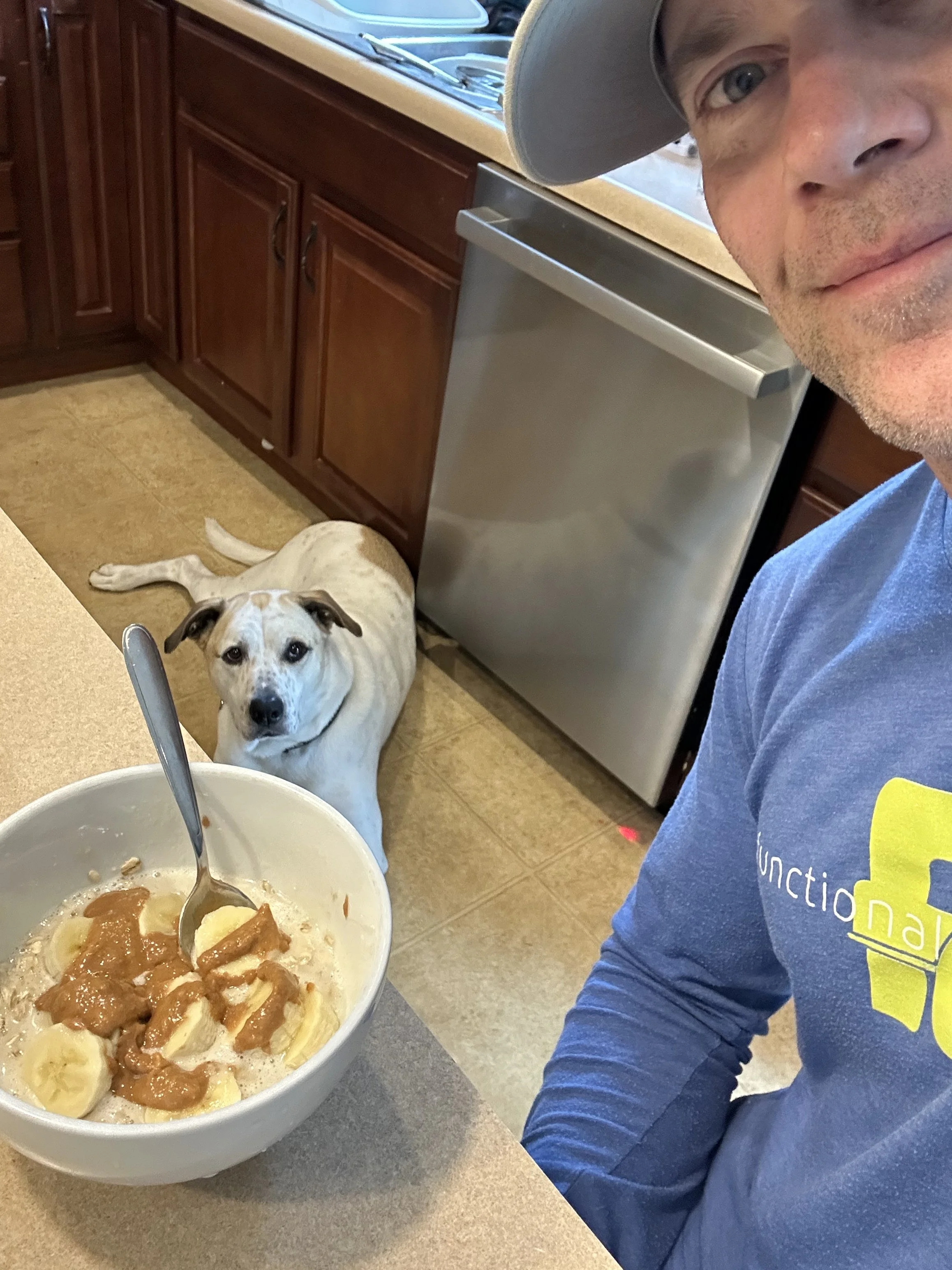
Small habits matter. One better meal. One better choice. One step forward. That’s how real change starts.
Not a full diet overhaul.
Not “clean eating.”
Not perfection.
Just one consistently better meal per day.
Maybe it’s a higher-protein breakfast.
Maybe it’s packing lunch instead of grabbing fast food.
Maybe it’s cooking dinner at home three nights a week.
Pick the meal that feels the most manageable and repeat it until it becomes automatic.
Then move to the next one.
Real progress is built through repetition — not intensity.
The Counterintuitive Strategy That Actually Works
Now here’s the surprising part.
If nutrition is your biggest struggle, it may actually make sense to start with exercise first.
Sounds backwards, right?
But for many people, exercise is emotionally easier to approach than food.
Food is personal.
Food is social.
Food is emotional.
Food is tied to routines, stress, comfort, travel, family, celebrations, and habits built over decades.
Movement tends to carry less baggage.
That’s why starting with simple exercise habits can create momentum without feeling overwhelming.
And no — this does not mean crushing yourself in the gym six days a week.
We’re talking about:
Walking 2–3 times per week
15–20 minutes at a time
No special equipment
No complicated plan
Just movement
That’s enough to start changing the trajectory.
Why Small Habits Matter More Than Big Bursts

You don’t need the perfect workout plan to move your health forward. Start with movement. Build from there.
This is where things begin to compound.
You move more consistently.
You sleep a little better.
Energy improves.
Stress becomes easier to manage.
And something interesting happens:
You naturally start making slightly better food choices.
Not because someone forced you to.
Not because you suddenly became “perfect.”
But because momentum creates alignment.
One better decision often leads to another.
A short walk becomes a routine.
One quality meal becomes two.
Consistency starts replacing motivation.
And that’s where lasting transformation actually happens.
The Best Fitness Plan Is the One You Can Sustain
At Functional Elements Training & Nutrition here in Creve Coeur, MO, we work with many adults throughout the St. Louis area who have spent years believing they needed the “perfect” plan before starting.
They don’t.
Most people don’t need a more aggressive plan.
They need a more sustainable one.
The goal is not to win for one week.
The goal is to build habits that still exist one year from now.
That starts smaller than most people think.
Sometimes the Hardest Part Is Knowing Where to Begin
One of the biggest things we hear from people at Functional Elements is this:
“I know I need to do something… I just don’t know where to start.”
That’s exactly why we do what we do.
For some people, the best starting point is strength training.
For others, it’s improving nutrition habits.
For others, it’s simply creating structure and accountability again.
The important thing is finding an approach that feels realistic, sustainable, and built around your actual life — not somebody else’s extremes.
Because fitness that works for two weeks isn’t the goal.
Fitness that still works years from now is.
Frequently Asked Questions
What is the best way to start getting healthy?
The best way to start getting healthy is to begin with small, sustainable habits like walking consistently or improving one meal per day instead of trying to change everything at once.
Should I start with diet or exercise first?
For many people, starting with exercise first can feel less overwhelming than changing nutrition habits immediately. Consistent movement often creates momentum that positively influences food choices over time.
How often should beginners exercise?
Beginners can benefit from exercising or walking just 2–3 times per week for 15–20 minutes consistently. The key is building a habit that feels sustainable long term.
Why do most fitness plans fail?
Many fitness plans fail because people try to change too much too quickly. Long-term success usually comes from small, repeatable habits built over time.
Just Start Somewhere
You do not need the perfect workout program.
You do not need the perfect diet.
You do not need perfect motivation.
You need a starting point.
(For clients who choose Functional Elements as a resource, our 14-day 360 is just that.)
Then you protect that starting point long enough for it to become a habit.
That’s how real change happens.
Slowly.
Consistently.
Repeatedly.
Start small.
But start.
And don’t forget this simple, but important rule …
GIVE YOUR BODY WHAT IT NEEDS, WHEN IT NEEDS IT!
Jaime Rothermich RD CSSD LD PPSCxKB PPSC
@functionalelements
functionalelements.net
If you’re searching for evidence-based nutrition coaching and personal training in or around St. Louis, Missouri, these same principles form the foundation of the work we do every day at Functional Elements—helping adults build strength, lose weight sustainably, and improve long-term health. Check out our 14-day 360° to get you motivated, educated and aligned with the very best Functional Elements Training & Nutrition has to offer over a period of just 14 days.

The Most Important Information on an InBody Scan…
…(And What Actually Matters for Your Results)
If you’ve ever looked at your InBody scan results and felt overwhelmed—you’re not alone.
There are a lot of numbers.
A lot of graphs.
A lot of “metrics.”
But here’s the truth:
Most of it is noise. A few key pieces are signal.
If your goal is fat loss, strength, longevity, or simply feeling better in your body, only a handful of InBody metrics actually matter.
At Functional Elements Training & Nutrition, we use InBody scans as a decision-making tool, not a report card.
Let’s break down what matters most.
What Is an InBody Scan?
An InBody scan is a body composition analysis that measures:
Skeletal muscle mass
Body fat mass
Body fat percentage
Water levels
Segmental muscle distribution
Unlike a traditional scale, it shows what your weight is made of—not just the number.
1. Skeletal Muscle Mass (SMM) — The #1 Metric
This is the most important number on your scan.
Skeletal Muscle Mass (SMM) tells you how much functional muscle you have.
Why it matters:
Drives metabolism
Supports joints and reduces injury risk
Improves insulin sensitivity
Strongly tied to longevity and independence
Simple rule:
More (quality) muscle = better health and long-term outcomes
What to look for:
Are you maintaining or increasing muscle?
If you’re losing weight, are you preserving muscle?
Reality check:
If your weight is going down and your muscle is going down…
you’re not improving your body—you’re just shrinking it.
2. Body Fat Mass (BFM) — More Important Than Percentage
Most people focus on body fat percentage.
But the more useful number?
Total Body Fat Mass (in pounds)
Why it matters:
Shows how much actual fat you’re carrying
More actionable than percentages
Less influenced by hydration or muscle changes
What to look for:
Is body fat mass trending down over time?
Are changes sustainable—not extreme?
3. Body Fat Percentage (PBF) — Context, Not the Goal
Body fat % gets all the attention—but it needs context.
Why it matters:
Shows ratio of fat to total body weight
Helps categorize general health ranges
The problem:
It can change without real progress
Lose muscle → body fat % can go up
Gain muscle → body fat % may go down
Takeaway:
Use it as a supporting metric, not your primary target.
4. Weight — The Least Important “Big” Number
Yes, it’s on the sheet.
No, it’s not the priority.
Weight is simply the sum of:
Muscle
Fat
Water
Everything else
It tells you nothing about:
Strength
Health
Longevity
Body composition
Better question than “Did I lose weight?”
“What did I lose?”
5. Visceral Fat Level — A Key Health Indicator
Visceral fat is stored around your organs.
Why it matters:
Higher levels are linked to:
Heart disease
Type 2 diabetes
Metabolic dysfunction
What to look for:
Keep levels in a healthy range (typically under 10 on InBody scale)
Focus on steady reduction over time
6. Segmental Lean Analysis — Where Your Muscle Lives
This section shows how muscle is distributed across your body:
Arms
Legs
Trunk
Why it matters:
Identifies imbalances
Guides training focus
Helps prevent injury
Example:
Underdeveloped legs → prioritize squats, hinges, lunges
One side weaker → address asymmetry
What Actually Matters Most (Simplified)
If you want to simplify your entire InBody scan, focus on:
Skeletal Muscle Mass → increasing or stable
Body Fat Mass → decreasing (if fat loss is the goal)
Consistent trends over time
That’s it.
The Biggest Mistake People Make
They treat the InBody scan like a report card, instead of a feedback tool.
One scan means very little
Trends over time tell the story
Also remember:
Hydration impacts results
Time of day matters
Food (and alcohol!) intake matters
Consistency in testing conditions > perfection in numbers
Who Should Be Using InBody Scans?
InBody scans are especially valuable for:
Adults 40–70 focused on longevity and strength
Busy professionals who want efficient, data-driven training
Anyone investing in personal training and wanting measurable progress
Final Thought: What Your InBody Scan Should Really Tell You
At Functional Elements, we view an InBody scan like this:
It’s not about chasing numbers—it’s about building a better body.
And the best way to do that?
Strength train consistently
Eat adequate protein
Create a sustainable calorie deficit (if fat loss is the goal)
Stay consistent long enough for trends to emerge
Because in the end…
The goal isn’t just to weigh less.
It’s to be stronger, healthier, and more capable for life.
FAQ
What is the most important number on an InBody scan?
Skeletal Muscle Mass (SMM) is the most important metric because it drives metabolism, strength, and long-term health outcomes.
Is body fat percentage accurate on an InBody scan?
It can be useful, but it should not be the primary focus. Body fat mass (in pounds) and trends over time are more reliable indicators.
How often should you do an InBody scan?
Every 4–6 weeks is ideal, using consistent conditions (same time of day, hydration, etc.).
Are InBody scans worth it for people over 40?
Yes. They provide valuable insight into muscle loss, fat gain, and overall body composition—key factors in aging well.
_________________________________________________________________________________________________________________________________________
Ready to Improve Your Body Composition?
If you’re in the Creve Coeur or greater St. Louis area and want a structured, data-driven approach to training:
We’re here to help.
And remember ...
GIVE YOUR BODY WHAT IT NEEDS, WHEN IT NEEDS IT!
Tony Muyco III, CSCS, PPSC, PPSC*KB, CFSC
Functional Elements Training and Nutrition Center
Partner and Director of Training
(c) 314.401.5047
If you’re searching for evidence-based nutrition coaching and personal training in or around St. Louis, Missouri, these same principles form the foundation of the work we do every day at Functional Elements—helping adults build strength, lose weight sustainably, and improve long-term health. Check out our 14-day 360° to get you motivated, educated and aligned with the very best Functional Elements Training & Nutrition has to offer over a period of just 14 days.
I’m not gaining…but, I’m not losing either…WHY?
I know you.
You're up at 6am. Kids to get ready, a job to get to, and about 47 things on your mental to-do list before noon. You're trying to eat halfway decent. You're getting to the gym when you can — maybe once a week, sometimes twice if the stars align. You're not going off the rails.
And yet ... nothing is changing.
The scale isn't moving. Your energy is still mediocre at best. You don't feel like you're losing ground, but you sure don't feel like you're gaining any either.
Sound familiar?
The problem isn't that you're failing. The problem is that you're doing just enough to maintain ... but not quite enough to improve.
And the gap between those two things? It's smaller than you think.
The Myth of the Big Change
When people hit this wall, the natural instinct is to go all-in. New diet. Six days a week at the gym. Cut out everything. Make it hurt.
I get it. But I've been doing this long enough to know how that story ends. You go hard for two or three weeks, then life happens — a sick kid, a work deadline, a rough Thursday night — and suddenly you're back to square one with the added weight of feeling like you failed.
The all-or-nothing approach is almost always nothing.
What actually works? Doing just a little bit more than what you're currently doing. Not a lot more. A little more.
What "A Little More" Actually Looks Like
I'm not talking about a fitness overhaul. I'm talking about small, specific shifts that, done consistently over time, compound into real results.
Getting one strength training session in per week? Can you get two? Even 30 minutes counts. That's not a massive time commitment — but over the course of a year, you've doubled your training volume. That matters.
Walking occasionally? What if you added one more walk (or even add 10 minutes to the walk you can do) per week? Twenty minutes around the neighborhood while your kids ride their bikes. That's a win.
On the nutrition side — this is where people quietly sabotage themselves without realizing it — the shifts can be even smaller. Those two peanut M&Ms you grab off the counter that somehow always turn into the whole bag? That's not a character flaw. That's just how it works when the food is in front of you. One small decision, made consistently, has real impact.
Or take the Friday night drinks. Four becomes two. You still unwound. But you've cut a few hundred calories that weren't doing anything for you anyway — and you'll sleep better and feel better Saturday morning.
These aren't dramatic changes. But they're the kind that actually stick.
I Live This Too
Last week I had about 15 minutes between getting home from work and having to leave again to pick up Noah from school.
I hadn't eaten. And I knew if I didn't eat right then, it wasn't happening until 8:30 or 9pm. Not ideal.
I didn't have time to think about the perfect meal. I didn't stress about macros or whether everything was optimally timed. I just asked myself one question: what can I put together right now that still gets me toward the goal?
Protein first. Always protein first.
What followed wasn't pretty, but it worked. A Chomps beef stick. Siggi's yogurt. An apple. Some carrots. A slice of sourdough with a little peanut butter.
Was it a perfectly constructed meal? No. Did it hit my protein, keep me fueled, and get me out the door in time? Absolutely.
That's the point. You don't need perfect. You need good enough, right now. A decent decision made in a 15-minute window beats a great plan that never happens.
Just Do One More Thing.
You've got family. You've got commitments. There is no magical window of free time coming that's going to let you execute some perfect program. So stop waiting for that.
Ask yourself one question: What is one thing I could do more of this week that I'm currently not doing?
One more walk. One less drink. Protein at breakfast instead of skipping it. Stopping at two cookies instead of six.
Pick one. Do it consistently. Then next month, pick another one.
That's the process. No 30-day transformation. No dramatic overhaul. Just real, sustainable, and compounding progress — the kind that actually sticks.
You're closer than you think. You just need to nudge the needle, not reinvent the wheel.
As always ...
GIVE YOUR BODY WHAT IT NEEDS, WHEN IT NEEDS IT!
Jaime Rothermich, RD, CSSD, LD, PPSC*KB, PPSC
Functional Elements Training & Nutrition
TRAIN FOR LIFE
(c) 314.518.4875
functionalelements@gmail.comhttp://www.functionalelements.net
If you’re searching for evidence-based nutrition coaching and personal training in or around St. Louis, Missouri, these same principles form the foundation of the work we do every day at Functional Elements—helping adults build strength, lose weight sustainably, and improve long-term health. Check out our 14-day 360° to get you motivated, educated and aligned with the very best Functional Elements Training & Nutrition has to offer over a period of just 14 days.
Strength Training: The Most Powerful Tool We Have for Aging Well
If there’s one thing I’d encourage almost every adult—especially over 40 in the St. Louis area—to prioritize, it’s this:
Strength training.
Not because it’s trendy.
Not because it looks good on Instagram.
But because it directly impacts how long—and how well—you live.
Why Strength Training Matters More as You Age
As we age, our bodies naturally lose muscle, strength, and resilience. This process—called sarcopenia—can begin as early as your 30s and accelerates over time.
Without intervention, this leads to:
Decreased mobility
Increased body fat
Higher risk of injury and chronic disease
Loss of independence
Strength training is the most effective way to slow—and even reverse—this decline.
1. Muscle Is the Organ of Longevity
We often focus on heart health, cholesterol, or blood pressure.
But one of the most important (and overlooked) health markers?
Skeletal muscle.
Muscle plays a critical role in:
Metabolism
Blood sugar control
Hormonal balance
Movement and independence
Less muscle = higher risk of:
Falls
Fatigue
Metabolic dysfunction
More muscle = more resilience.
2. Strength Training Improves Metabolism (Even at Rest)
Muscle is metabolically active tissue.
That means the more muscle you have, the more efficiently your body:
Burns calories
Processes carbohydrates
Regulates energy
Strength training helps:
Preserve lean muscle during fat loss
Improve insulin sensitivity
Support sustainable weight management
At Functional Elements Training & Nutrition, we say it simply:
“Weight loss is math—but muscle makes the math work in your favor.”
3. Strength Training Reduces Pain and Protects Joints
A common mistake:
“I can’t lift because something hurts.”
In reality, not lifting is often why it hurts.
Proper strength training:
Strengthens muscles around joints
Improves alignment and stability
Reduces chronic pain (back, knees, shoulders)
Strong muscles act as a built-in support system for your body.
4. It Improves Balance, Coordination, and Prevents Falls
One of the biggest health risks as we age?
Falling.
Falls can lead to:
Fractures
Long recovery periods
Loss of independence
Strength training improves:
Balance
Coordination
Reaction time
Confidence in movement
And this doesn’t start at 65—it starts now.
You don’t wait until retirement to build your 401(k).
Don’t wait to build your strength either.
5. Strength Training Supports Bone Density
Strength training places controlled stress on your bones—which is exactly what they need.
This helps:
Maintain bone density
Reduce risk of osteoporosis
Lower fracture risk
Think of it as long-term insurance for your skeletal system.
6. It Improves Energy, Mood, and Confidence
This is where things go beyond physical health.
Clients consistently report:
More daily energy
Better sleep
Improved mood
Increased confidence
Because strength isn’t just physical—it’s psychological.
It shows up in:
Carrying groceries with ease
Playing with kids or grandkids
Moving through life without hesitation
Strength gives you options. And options equal freedom.
7. Strength Training Helps You Stay Independent Longer
At the end of the day, this is the real goal.
Not just living longer—but living better.
Strength training helps you:
Stay active
Stay capable
Stay independent
Because the alternative isn’t just aging.
It’s losing the ability to do the things you love.
Can You Start Strength Training After 40 (or 50, or 60)?
Yes—and you should.
Strength training is:
Safe when properly coached
Scalable to any fitness level
Effective at any age
You don’t need to train like an athlete.
You just need:
A plan
Proper coaching
Consistency
The Bottom Line: Strength Training Is Foundational for Aging Well
If your goal is to:
Move better
Feel better
Stay independent
Then strength training isn’t optional.
It’s foundational.
Start where you are.
Build the process.
Let the results follow.
Ready to Build Strength the Right Way?
If you’re in the St. Louis / Creve Coeur area and want a structured, personalized approach to TRAIN FOR LIFE ...
We’re here to help. It's what we do.
And remember, always ...
GIVE YOUR BODY WHAT IT NEEDS, WHEN IT NEEDS IT
Tony Muyco III, CSCS, PPSC, PPSC*KB, CFSC
Partner & Director of Training
Functional Elements Training & Nutrition Center
314.401.5047 http://www.functionalelements.net
If you’re searching for evidence-based nutrition coaching and personal training in or around St. Louis, Missouri, these same principles form the foundation of the work we do every day at Functional Elements—helping adults build strength, lose weight sustainably, and improve long-term health. Check out our 14-day 360° to get you motivated, educated and aligned with the very best Functional Elements Training & Nutrition has to offer over a period of just 14 days.
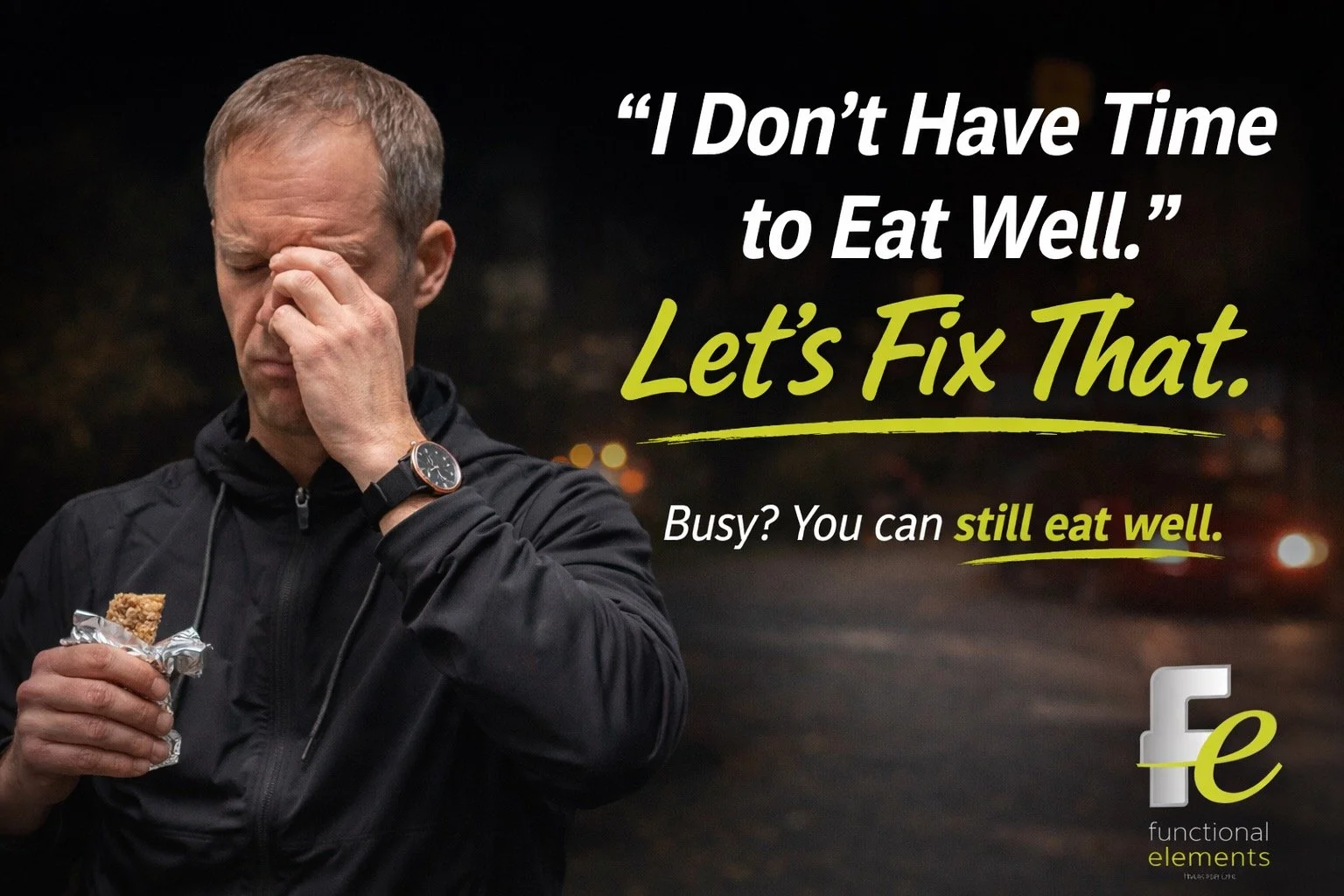
I Don’t Have Time to Eat Well!
Let me take a wild guess.
You’re busy. Really busy. Full-time job, kids to shuttle around, meetings stacked back-to-back, and by the time 6pm rolls around you’re running on fumes and the last thing you want to do is figure out what’s for dinner.
So you grab whatever’s fast. Or you skip the meal entirely. Or you pull through a drive-thru and tell yourself, *“I’ll do better tomorrow.”*
Sound familiar?
This is, without question, one of the biggest barriers I hear from our clients at Functional Elements. And look, I get it. I’m in the same boat, and I’m not going to stand here and tell you time isn’t a real constraint. It is.
But here’s what I *will* tell you:
The problem isn’t actually time. The problem is how you’re thinking about it.
THE REFRAME
Most people treat nutrition like a separate task to fit into an already packed schedule — something extra to DO. Cook a meal. Prep the food. Plan the week.
What if it wasn’t extra at all? What if eating well was just… your default?
Here’s what I mean. You already eat every day. You’re already spending time and money on food, one way or another. The question isn’t “do I have time to eat?” — it’s “am I eating with a purpose?”
That shift in thinking? That’s the entire ballgame.
I say it all the time and I’ll say it again: GIVE YOUR BODY WHAT IT NEEDS, WHEN IT NEEDS IT.
That’s not a complicated philosophy. But it does require some intention. And with that intention, I promise you, the time barrier starts to shrink.
One more thing before we get into the actions. Stop waiting for the “perfect” time to start. There is no perfect time. Not next Monday. Not January 1st. Not after the holidays, after the big project at work, after spring break, or after the kids’ season wraps up. As I’ve told clients many times, stop the mental gymnastics. You can make it better than your default *right now*, even in your busiest season.
3 REALISTIC ACTIONS TO GET AROUND THE TIME BARRIER
Action #1: Embrace the Power of “Good Enough” Meals — Not Perfect Ones
Here’s a trap I see all the time: people think that eating well requires elaborate meal prep, Instagram-worthy recipes, and hours in the kitchen on Sunday. Then, when that doesn’t happen, nothing happens.
Drop that expectation. Right now.
Your goal is PROTEIN FIRST at every meal. That’s it. Start there.
If you can get 20-30g of protein at breakfast, lunch, and dinner, you are winning — even if that looks like:
- Greek yogurt (Siggi’s is my go-to) + a couple of hard-boiled eggs in the morning
- Leftover ground beef or grilled chicken thrown on top of some greens for lunch
- A rotisserie chicken pulled from the store on the way home and paired with whatever vegetables are easiest
None of that is fancy. None of that takes more than 10 minutes. And all of it is head-and-shoulders better than skipping a meal, grabbing a bag of chips, or outsourcing three meals a day to a drive-thru.
Here’s the thing that most people don’t realize: if you have a plan for your protein, you’re already ahead of the game. Carbs, fruit, and vegetables? Those are easy. Grab an apple on the way out the door. Throw some frozen veggies in the microwave. Add a handful of berries to your yogurt. That stuff doesn’t require much thought, time, or planning. The heavy lifting — mentally and nutritionally — is always the protein. Nail that, and the rest of the plate takes care of itself.
Simpler is better. I say this all the time and I mean it. Progress beats perfection every single time.
Action #2: Use Strategic Convenience — Not Convenience as an Excuse
I’m not a huge fan of protein bars as a regular staple, but you know what? A Barebell Bar, an Epic Bar, or a 1st Phorm Level-1 Bar when you’re running between meetings or your kids’ activities? That’s using convenience *strategically*. That’s smart.
There’s a difference between using convenient options as a tool and using them as a crutch.
Tools are purposeful. Tools fill in gaps. Tools keep you from making a terrible decision at 3pm when you’re starving and standing in front of a vending machine.
Here’s the framework: Is this the best option available to me right now, given my situation?
If the answer is yes — great. Eat it with purpose. Move on.
This might look like:
- Keeping ready-to-eat proteins accessible.** Hard-boiled eggs in the fridge. Beef sticks (20g of protein per stick — yes, really) in your bag or desk. A container of cottage cheese. A scoop of whey protein in a shaker bottle. These aren’t exotic. They take zero cooking time.
- Leaning on single-ingredient whole foods.** Eggs. Steak. Ground beef. Whole chicken. These have been fueling humans for millennia — they don’t require a recipe. They require a pan and 10 minutes.
- Anchoring your grocery list around what’s fast AND nutritious.** Eggs. Greek yogurt. Ground beef. A whole chicken. Avocados. Berries. Pre-washed greens. That grocery run takes 20 minutes and sets you up for a week of easy, high-quality nutrition.
The bottom line? Convenience is fine. Intentional convenience is even better. The goal is to make protein-first eating the path of least resistance in your life.
-----
Action #3: Build a Routine — And Protect It Like It’s Non-Negotiable
This is the one most people skip, and it’s the most powerful of all.
I’ve written about the magic of routine before because I believe in it that much. When you eat at consistent times, your body gets into a rhythm. You can predict when hunger will hit. You stop making impulsive, reactive food decisions because you’re not white-knuckling your way through starvation at 2pm.
For busy working parents, routine is especially powerful because it removes decision fatigue. You’re already making a hundred decisions a day. The less you have to think about food, the better your food choices become.
Here’s what I’d suggest as a starting point — commit to just three non-negotiables:
1. Eat breakfast with protein. Not a bowl of cereal (dessert with a commercial jingle attached to it). Something with 20-25g of protein minimum. Eggs, yogurt, a protein shake, leftover meat — whatever works. This sets the tone for the entire day. It reduces cravings, stabilizes energy, and cuts down on the mid-morning “I’ll just grab something from the break room” spiral.
1. Have a plan — even a rough one — for dinner before 3pm. You don’t need a meal plan binder. You just need to know *something* before the chaos of the evening hits and decision-making goes out the window. Rotisserie chicken tonight? Great. That’s a plan. Ground beef and whatever’s in the fridge? Perfect. Forty seconds of intentional thought at 2pm beats forty minutes of drive-thru regret at 7pm.
1. Eat at roughly the same times each day. Breakfast around the same time. Lunch around the same time. Dinner around the same time. This isn’t about rigidity — it’s about rhythm. When you eat like clockwork, your body works with you, not against you. Energy stays more stable. Hunger becomes predictable. And you’re far less likely to find yourself making poor choices because you’re ravenous and reactive.
THE BOTTOM LINE
Time is real. I’m not dismissing it. But here’s the truth: you don’t need *more* time to eat well. You need *less chaos* around eating — and that comes from intention, routine, and a willingness to stop chasing perfection.
Start with ONE action from this list. Just one. Do it consistently for two weeks. Then layer in another.
That’s the process. That’s how it works. That’s what I’ve watched clients do again and again — not by overhauling their entire life in a weekend, but by showing up with a little more intention than the day before.
And when you need help building that personalized game plan for YOUR schedule, YOUR goals, and YOUR life? That’s exactly what we do at Functional Elements.
Let’s get to work.
GIVE YOUR BODY WHAT IT NEEDS, WHEN IT NEEDS IT.
Jaime Rothermich, RD, CSSD, LD, PPSC*KB, PPSC
Functional Elements Training & Nutrition
TRAIN FOR LIFE
(c) 314.518.4875functionalelements@gmail.comhttp://www.functionalelements.net
If you’re searching for evidence-based nutrition coaching and personal training in or around St. Louis, Missouri, these same principles form the foundation of the work we do every day at Functional Elements—helping adults build strength, lose weight sustainably, and improve long-term health. Check out our 14-day 360° to get you motivated, educated and aligned with the very best Functional Elements Training & Nutrition has to offer over a period of just 14 days.

Grip Strength: The Most Overlooked Predictor of Strength, Health, and Longevity
If I could give you one simple test to gauge your overall strength and long-term health…
I wouldn’t have you bench press.
I wouldn’t have you squat.
I would test your grip strength.
That might sound surprising—but it shouldn’t.
Grip strength isn’t just about your hands.
It’s a reflection of your entire system.
Why Grip Strength Matters More Than You Think
Grip strength is one of the strongest indicators we have of:
Total body strength
Muscle mass
Nervous system health
Functional independence as we age
And even… longevity
There’s a reason researchers consistently find that individuals with lower grip strength have higher risks of:
Cardiovascular disease
Mobility limitations
Falls and fractures
All-cause mortality
In other words—
weak grip, weak system.
Grip Strength = Real-World Strength
Let’s take it out of the lab and into real life.
Grip strength shows up in:
Carrying groceries
Picking up your kids or grandkids
Opening jars
Holding onto weights
Preventing falls (literally holding on)
At Functional Elements, we talk a lot about training for life—not just for the gym.
Grip strength is exactly that.
Because when your grip goes… everything else tends to follow.
The Muscle You Can’t See (But Should Train)
Here’s what most people miss:
Your grip is heavily tied to your posterior chain and upper body strength.
If your grip is weak, it often limits:
Deadlifts
Rows
Pull-ups
Carries
Which means you’re not just training your hands less—
you’re training your entire body less effectively.
Stronger grip =
→ Heavier lifts
→ More muscle stimulus
→ Better results
The Aging Factor: Where This Really Matters
This is where grip strength becomes non-negotiable.
As we age, we naturally lose:
Muscle mass (sarcopenia)
Strength
Neuromuscular efficiency
Grip strength is often one of the first things to decline—and one of the most telling.
Think of it as an early warning system.
Because the goal isn’t just to live longer.
It’s to maintain the ability to:
Carry your own luggage
Stay independent
Stay active
Stay confident in your body
The Simple Test
Here’s a quick gut-check:
Can you hang from a bar for 20–30 seconds?
Can you carry heavy kettlebells without dropping them early?
Does your grip give out before your legs or back?
If the answer is yes—your grip is limiting you.
How to Improve Grip Strength (Without Overcomplicating It)
You don’t need fancy tools.
You need intention.
Start here:
1. Carry Heavy Things
Farmer’s carries
Suitcase carries
Trap bar holds
Simple. Effective. Brutal (in a good way).
2. Hang More
Dead hangs from a pull-up bar
Progress to longer holds or one-arm variations
This is one of the most underrated exercises you can do.
3. Stop Relying on Straps
Straps have their place—but if you use them too early, you rob yourself of grip development.
Earn the right to use them.
4. Train It Directly (Optional Layer)
Plate pinches
Towel grips
Fat grip implements
These are great—but only after you’re consistently loading carries and hangs.
The Bigger Picture
Grip strength is one of those things that seems small…
Until you realize it touches everything:
Strength
Performance
Injury risk
Independence
Longevity
It’s not flashy.
But it’s foundational.
Final Thought
At Functional Elements, we’re always asking:
“What actually matters long-term?”
Grip strength is one of those answers.
So next time you’re in the gym—
don’t rush past it.
Train it.
Challenge it.
Pay attention to it.
Because one day…
you won’t care what you could bench.
You’ll care that you can still hold on.
Need help in incorporating grip strength strategies into your program? We’re here.
And remember, Give Your Body What It Needs, When It Need It.
Tony Muyco III, CSCS, PPSC, PPSC*KB, CFSC
Functional Elements Training and Nutrition Center
Partner and Director of Training
(c) 314.401.5047
If you need a kickstart to get your fitness, nutrition and recovery program properly synched, we can help. It's what we do. Check out our 14-day 360• to get you motivated, educated and aligned with the very best Functional Elements Training & Nutrition has to over, over a period of just 14 days.
I’m Making My Own Sourdough! (here’s why)
The Top 3 Reasons I Make My Own Sourdough
If you’ve been around my kitchen lately, you’ve probably seen a jar of flour and water quietly bubbling on the counter. That’s my sourdough starter — and yes, it’s alive (and I get a lot of eye rolls around my house).
Making sourdough at home has become a bit of a ritual (or obsession) for me. It takes patience, a little trial and error, and occasionally some flour on the ceiling. But once you get the hang of it, the process becomes incredibly rewarding.
Here are my three main reasons I keep making my own sourdough instead of buying bread at the store.
1. It’s Easier on Digestion
Most store-bought bread is made fast. Really fast. The dough might only ferment for an hour or two before it’s baked.
Sourdough is the opposite.
When you make sourdough the traditional way, the dough ferments slowly — often 12–15 hours. During that time, wild yeast and beneficial bacteria begin breaking down parts of the flour.
What that means in practical terms:
The gluten structure is partially broken down
Certain compounds that can irritate the gut are reduced
The bread is often easier for people to digest
A lot of people who feel bloated after regular bread notice they tolerate sourdough much better.
2. You Actually Get More Nutrition From the Grain
Grains naturally contain something called phytic acid, which binds to minerals like iron, magnesium, and zinc and makes them harder for your body to absorb.
During sourdough fermentation, natural enzymes break down a portion of these compounds.
The result?
Your body can potentially absorb more of the nutrients that are already in the flour.
It’s still bread — not a miracle food — but it’s a more traditional and biologically friendly way to prepare grains.
3. The Ingredients Are Refreshingly Simple
Pick up most loaves of bread at the grocery store and the ingredient list reads like a chemistry project.
Conditioners. Preservatives. Stabilizers. Added sugars.
A traditional sourdough loaf has four ingredients:
Flour
Water
Salt
Time
That’s it.
And honestly, when you pull a loaf out of the oven with a crackly crust and that incredible smell filling the kitchen, you realize something pretty quickly:
Bread was never supposed to be complicated.
A Bonus Reason (That I Didn’t Expect)
There’s something strangely satisfying about making sourdough.
You feed the starter.
You watch the starter then the dough rise.
You fold and shape it.
You bake it.
In a world where most of our food comes from a package, sourdough reminds you that good food doesn’t need to be rushed.
Just flour, water, salt, and patience… and maybe a little butter when it’s still warm.
Jaime Rothermich, RD, CSSD, LD, PPSC*KB, PPSC
Functional Elements Training & Nutrition
TRAIN FOR LIFE
(c) 314.518.4875
functionalelements@gmail.com
http://www.functionalelements.net
If you’re searching for evidence-based nutrition coaching and personal training in or around St. Louis, Missouri, these same principles form the foundation of the work we do every day at Functional Elements—helping adults build strength, lose weight sustainably, and improve long-term health. Check out our 14-day 360° to get you motivated, educated and aligned with the very best Functional Elements Training & Nutrition has to offer over a period of just 14 days.

The Importance of Strong Feet and Ankles
A client recently said to me after the performing our 6 Phase Warm-Up, “Is it time for calf raises and anterior tib raises? Man, we do a lot of those.” My response, “We sure do. It’s important to have a strong base.”
When most people think about strength training, they think about the big muscles: legs, glutes, core, chest, shoulders.
But one of the most important strength systems in your body sits at the very bottom.
Your feet and ankles.
Just like a foundation of a building, your feet and ankles are the foundation of everything you do—walking, running, lifting, jumping, balancing, even standing in line at the grocery store.
And if the foundation is weak, everything built on top of it becomes less stable.
Your Feet: The Foundation of the Entire Kinetic Chain
Each foot contains 26 bones, 33 joints, and over 100 muscles, tendons, and ligaments. That’s an incredible amount of engineering packed into a small structure.
Their job is to:
Absorb force
Create stability
Transfer power
Maintain balance
Provide sensory feedback to the brain
When the feet are strong and responsive, the body moves efficiently.
When they’re weak or unstable, the body compensates.
And compensation is where injuries start.
Weak Feet Lead to Problems Up the Chain
In training and rehab settings, we often see the same pattern.
Weak or poorly functioning feet can contribute to:
Plantar fasciitis
Achilles irritation
Shin splints
Knee pain
Hip instability
Lower back discomfort
Why?
Because if the foot collapses or loses stability, the ankle rolls inward, the knee caves, and the hip loses alignment.
Think of it like the foundation of a house shifting—everything above it starts to tilt.
Balance and Longevity
For adults over 40, strong feet and ankles become even more important.
As we age, the body naturally loses:
Muscle mass
Proprioception (body awareness)
Balance
Your feet are loaded with sensory receptors that constantly communicate with the brain about your position in space.
Strong, responsive feet improve:
Balance
Coordination
Stability when walking
Fall prevention
This is one of the most overlooked keys to staying independent and active later in life.
Athletic Performance Starts at the Ground
Every movement begins with force into the ground.
Stronger feet and ankles help improve:
Jumping power
Sprint speed
Change of direction
Lifting stability
Energy transfer through the body
Athletes with strong feet can produce and absorb force more efficiently, which improves both performance and durability.
Simple Ways to Strengthen Your Feet and Ankles
The good news is that foot strength can improve quickly with a few simple habits.
1. Train Barefoot (When Appropriate)
Barefoot training activates the small and intricate muscles of the feet.
Great options:
Balance work
Mobility drills
Light strength training
2. Balance Training
Single-leg balance exercises challenge the ankle and foot stabilizers.
Examples:
Single-leg stands
Balance pads
Controlled step-downs
3. Calf and Ankle Strength
The calves and Achilles work closely with the foot.
Important exercises include:
Heel raises
Eccentric calf work
Ankle mobility drills
The Big Picture
At Functional Elements, we often remind clients:
You can’t build a strong body on a weak foundation.
Strong feet and ankles improve:
Stability
Movement quality
Injury resistance
Athletic performance
Longevity
And the best part?
They don’t require complicated equipment—just a little attention to the part of the body most people ignore.
Because when your foundation is strong, everything above it performs better. That’s how you Train for LiFE.
Need help in strengthening your base, we’re here.
And remember: Give your body what it needs, when it needs it.
Tony Muyco III, CSCS, PPSC, PPSC*KB, CFSC

Stop Undereating Protein: The 40+ Wake-Up Call
If you’re over 40+, protein is no longer about chasing muscle size.
It’s about protecting your future. Think of this as a health span savings account.
As we age, our bodies require 25–50% more protein per meal compared to someone in their 20s to stimulate the same muscle-building response. Why? Because of something called anabolic resistance — aging muscle becomes less sensitive to protein.
In your 20s:
~20g of protein may effectively stimulate muscle protein synthesis.
In your 40s, 50s, and beyond:
It often takes 30–40g per meal to get that same effect.
That’s not “high protein.”
That’s age-appropriate protein.
Muscle Loss Is Real (But Preventable)
Beginning in our 30s, we can lose 3–8% of muscle mass per decade — faster after 50. Precipitous after 70.
Less muscle means:
Slower metabolism
Poorer blood sugar control
Increased injury and fall risk
Increased risk of disease
Protein + resistance training is the solution.
Protein Protects During Fat Loss
Adults 40+ often want fat loss. But if protein is too low in a calorie deficit, muscle loss accelerates.
That’s why even in a 2,100-calorie deficit framework, protein could remain as high as 120g+ per day.
Bone, Blood Sugar, and Longevity
Protein also:
Supports bone density (bone is ~50% protein matrix)
Improves satiety and blood sugar stability
Reduces frailty risk long-term
For adults, it becomes the anchor macronutrient.
Practical Target for 40+
.7-1.0g per pound (1.5-2.2g kg) of bodyweight daily (or target body weight)
30–40g per meal
Spread across 3–4 meals
This often means 15–30g more per day than someone in their 20s.
This isn’t about trying to look 25 again.
It’s about protecting your “65-year-old” body.
Protein isn’t extreme.
It’s appropriate.
Jaime Rothermich, CSSD, LD, PPSC*KB, PPSC
Functional Elements Training & Nutrition
TRAIN FOR LIFE
(c) 314.518.4875
functionalelements@gmail.com
http://www.functionalelements.net
If you’re searching for evidence-based nutrition coaching and personal training in or around St. Louis, Missouri, these same principles form the foundation of the work we do every day at Functional Elements—helping adults build strength, lose weight sustainably, and improve long-term health. Check out our 14-day 360° to get you motivated, educated and aligned with the very best Functional Elements Training & Nutrition has to offer over a period of just 14 days.

What Cardio Zone Should You Be Doing?
Here at FE, we stress Consistency is King. 3 main areas to focus on to reach or maintain your goals are Training, Nutrition, and Recovery. At FE, we can take care of one aspect of training. You know you are going to get a great strength workout with one of our excellent coaches. You WILL get stronger, more stable, and more mobile. Another aspect of training is Conditioning. Whiles some form of conditioning is performed in your training program, to get over that hump, and get the results you’re trying to achieve, we stress to perform cardio sessions on your off days. Yes, I said it, that dreaded word, Cardio.
But cardio isn’t just cardio.
There’s a massive difference between mindlessly sweating for 30 minutes and intentionally training in the right cardio zone for your goals, your age, and your physiology.
If you’ve ever wondered:
“Am I pushing too hard?”
“Why am I exhausted but not improving?”
“Why do some people walk and get fitter while others run themselves into the ground?”
This is where cardio zones come in. Had a client recently asked me what should I be doing?
Let’s break it down.
What Are Cardio Zones?
Cardio zones are simply ranges of heart rate that correspond to different levels of effort and different physiological benefits.
They’re typically divided into 5 zones, based on a percentage of your maximum heart rate.
A simple estimate for max heart rate is:
220 – your age = estimated max heart rate
Example:
A 50-year-old:
220 – 50 = 170 bpm max
From there, zones are calculated as percentages.
The 5 Cardio Zones (And What They Actually Do)
Zone 1: Recovery Zone (50–60%)
Very easy effort
Slow walking
Light cycling
Warm-ups and cool-downs
Benefits:
Improves circulation
Promotes recovery
Reduces stress
This is not fitness-building cardio.
It’s recovery cardio.
Zone 2: The Longevity Zone (60–70%)
Comfortable, sustainable effort
You can talk in full sentences.
This is the zone I recommend most of clients.
Benefits:
Improves mitochondrial health
Builds aerobic base
Improves fat metabolism
Supports heart health
Improves recovery
Enhances longevity
This is where magic happens.
Zone 3: The Gray Zone (70–80%)
Moderate effort
Talking becomes harder.
This is where many people accidentally spend most of their cardio time.
Here’s the problem:
Too hard to be easy
Too easy to be truly effective
You accumulate fatigue without maximum benefit.
This is the most overused—and often least productive—zone.
Zone 4: Threshold Zone (80–90%)
Hard effort
Talking is very difficult.
Benefits:
Improves cardiovascular capacity
Increases performance
Improves VO₂ max
This is powerful—but should be used strategically.
Not daily.
Zone 5: Max Effort (90–100%)
All-out effort
Sprinting.
Short intervals.
Benefits:
Improves VO₂ max dramatically
Builds power
Improves fitness ceiling
This is extremely effective.
But also extremely taxing.
The Biggest Mistake Most Adults Make
Most adults live in Zone 3.
They push harder than necessary because:
They think harder = better.
But this often leads to:
Excess fatigue
Poor recovery
Increased injury risk
Burnout
Limited progress
More sweat doesn’t always equal more results.
Smarter equals better.
Which Zone Is Right for You?
For most of our adult clients, the answer is:
Mostly Zone 2
with occasional Zone 4–5
Here’s a simple framework:
Zone 2:
2–4 sessions per week
30–60 minutes
Examples:
Incline treadmill walking
Outdoor walking
Cycling
Elliptical
Zone 4–5:
1–2 short sessions per week
Examples:
Short intervals
Hill climbs
Bike sprints
Why Zone 2 Is So Powerful—Especially After 40
As we age, we naturally lose:
Aerobic capacity
Mitochondrial function
Recovery ability
Zone 2 directly improves all three.
This means:
Better energy
Better fat loss
Better heart health
Better recovery
Better aging
It’s one of the highest-return investments you can make.
How To Know You’re In The Right Zone (Without Math)
Here’s the simplest Functional Elements test:
Zone 2 = You can talk, but not sing.
If you’re gasping for air → too hard
If you can sing easily → too easy
Slightly challenged, but sustainable.
What This Looks Like In Real Life
For many of our clients:
It’s not running.
It’s incline walking.
Often at:
3.0 – 4.0 mph
Incline 4–8%
Heart rate elevated.
Breathing elevated.
But sustainable. And incredibly effective.
The Bottom Line
Cardio isn’t about destroying yourself.
It’s about training your heart intelligently.
For most adults over 40:
Zone 2 builds your base.
Zone 4–5 builds your ceiling.
Strength training builds your body.
Combined together? Results happen. Training for life happens.
Need help in designing the right cardio options for you. We are here.
And remember, Give Your Body What It Needs, When It Needs It.
Tony Muyco III, CSCS, PPSC, PPSC*KB, CFSC
Functional Elements Training and Nutrition Center
Partner and Director of Training
(c) 314.401.5047
If you need a kickstart to get your fitness, nutrition and recovery program properly synched, we can help. It's what we do. Check out our 14-day 360• to get you motivated, educated and aligned with the very best Functional Elements Training & Nutrition has to over, over a period of just 14 days.

Stop Chasing Your 22-Year-Old Body
If you’re 45 (or more!) trying to weigh what you did at 22… we need to reset the target.
Not because you “can’t” lose weight.
But because your life — and your body — are not the same.
And that’s not a failure.
Your Context Has Changed
In your 20s you likely had:
Fewer responsibilities
More free time
Lower stress
Better recovery
Fewer joint issues
Now you’re managing:
Career demands
Kids and family logistics
Sleep disruption
Hormonal shifts
Higher stress loads
You cannot apply a 22-year-old strategy to a 45-year-old body and expect the same result.
More cardio and less food is not the answer.
The Real Goal Isn’t Your Old Weight
When we talk with our 40+ clients at Functional Elements, they say they want their old weight back or old body back (and don’t we all!)
But what they actually want is:
Energy
Confidence
Strength
To feel athletic again
To age well
Those things don’t require your high school body.
They require muscle.
Muscle Is the New Skinny
After 40, your focus should shift to:
Strength training consistently
Prioritizing protein
Managing stress
Sleeping better
Supporting recovery
A strong 45-year-old often weighs more than they did at 22 — but looks better, moves better, and feels better.
The scale doesn’t tell the full story.
A Better Benchmark
Instead of asking,
“Why don’t I weigh what I did in 1998?”
Ask:
Am I stronger than last year?
Is my body more resilient?
Am I training for life — not punishment?
Can I do the things I want to do when I want to do them?
You’re not supposed to look 20 at 45.
You’re supposed to look like a well-trained, well-nourished, resilient adult who takes care of themselves.
That’s the win.
Let’s stop chasing the past — and start reframing your mindset…building a body that supports the life you have now.
GIVE YOUR BODY WHAT IT NEEDS, WHEN IT NEEDS IT!
Jaime Rothermich, CSSD, LD, PPSC*KB, PPSC
Functional Elements Training & Nutrition
TRAIN FOR LIFE
(c) 314.518.4875
functionalelements@gmail.com
http://www.functionalelements.net
If you’re searching for evidence-based nutrition coaching and personal training in or around St. Louis, Missouri, these same principles form the foundation of the work we do every day at Functional Elements—helping adults build strength, lose weight sustainably, and improve long-term health. Check out our 14-day 360° to get you motivated, educated and aligned with the very best Functional Elements Training & Nutrition has to offer over a period of just 14 days.

The Importance of Community at FE
Why Building Connections Enhances Your Fitness Journey
If you’ve ever started a training program feeling fired up, only to quietly fall off a few weeks later, you’re not alone. One of the biggest missing pieces is not motivation, discipline, or the perfect program. It’s community.
Fitness is often seen as a personal journey, but the value of community within training environments cannot be overstated. Whether you're working out at a facility for 1-on-1 personal training or joining a group session, the sense of belonging that comes from shared goals and mutual support plays a crucial role in maintaining motivation and achieving results. Here at Functional Elements, we are proud of the environment, culture and sense of family support our clients have built. As one of your clients, Lamia, states,
“The environment is also a huge plus. The clientele ranges from beginners to advanced, yet everyone feels welcome. It truly feels like a supportive fitness community where you’re encouraged and challenged.”
Community Improves Consistency…And Consistency Drives Results
A strong community provides encouragement and accountability, helping individuals stay committed to their fitness routines. When our clients support each other, celebrate milestones, and offer constructive feedback, it fosters an atmosphere where everyone feels inspired to push their limits and challenge themselves. This positive reinforcement makes it easier for everyone to consistently stick to their program to overcome challenges and setbacks that might otherwise derail progress. From Mary,
“Right from the start I felt that I was in a supportive community that would allow me to ease back and stick to an exercise routine.”
Community Creates a Tribe, Knowing You’re Not Alone in Your Journey
“It's fun getting to know other people and learning about their own fitness journeys!”, says Mike. Beyond motivation, community involvement can lead to lasting friendships and a sense of camaraderie. Small group workouts, and even our 1-on-1 clients, often build trust and create opportunities for social interaction, which can reduce their feelings of isolation and make training fun. These relationships extend outside the gym, contributing to overall well-being and a positive outlook on health. We are always happy to hear when clients interact outside the walls of FE.
The Bottom Line…
Your training program matters. Your nutrition plan matters. Your recovery matters. But your environment may matter, more than you know.
A sense of community is a vital ingredient in successful fitness training. It motivates people to strive for their goals, offers emotional support, and builds lasting connections that make the fitness journey rewarding. At FE, we believe fitness is not meant to be done in isolation. We’ve seen progress happen at its best, and sticks the longest, when our clients surround themselves with others that support them. Strength is not only built with weights. It’s also built with people.
Need help with surrounding yourself with others to support your fitness goals…We’re here.
And remember, Give your body what it needs, when it needs it.
Tony Muyco III, CSCS, PPSC, PPSC*KB, CFSC
Functional Elements Training and Nutrition Center
Partner and Director of Training
(c) 314.401.5047
functionalelements@gmail.com
http://www.functionalelements.net
If you need a kickstart to get your fitness, nutrition and recovery program properly synched, we can help. It's what we do. Check out our 14-day 360• to get you motivated, educated and aligned with the very best Functional Elements Training & Nutrition has to over, over a period of just 14 days.
The Busy Adult’s Nutrition Blueprint
A Realistic Approach to Healthy Eating for Busy Adults
Eating healthy shouldn’t feel like a second job.
Yet for busy parents, professionals, and adults over 40, most nutrition advice is unrealistic. Tracking calories, prepping every meal, and chasing perfection simply doesn’t fit real life.
The good news?
You don’t need a strict diet — you need a simple system that works with your schedule (not against it).
Why Most Nutrition Plans Don’t Work for Busy Adults Over 40
Between long workdays, family responsibilities, stress, and limited time, most people don’t fail because of lack of effort.
They fail because the plan:
Requires too much tracking
Demands too much time
Leaves no room for flexibility
A sustainable nutrition approach has to work during busy weeks (your hardest weeks), not just when life is calm.
Step 1: Focus on Consistency, Not Perfection
You don’t need perfect meals.
You need repeatable habits.
Instead of asking, “What’s the best diet?”
Ask: “What can I realistically do most days?”
Simple meals. Familiar foods. Less overthinking.
That’s how progress sticks.
Step 2: Prioritize Protein at Every Meal
(I may have said this a time or two)
For adults over 40+, protein is the most important nutrition priority.
Protein helps:
Maintain muscle mass
Improve energy and recovery
Reduce cravings and overeating
You don’t need to count macros — just ask:
“Where is my protein coming from?”…each and every meal.
Step 3: Use a Simple Plate Structure
Skip measuring and tracking.
Most meals should include:
Protein: palm-sized portion (3-4oz.)
Vegetables: fist-sized portion (at minimum)
Carbs and Fats: added intentionally
This works whether you’re eating at home, at a restaurant, or grabbing food on the go around our St. Louis/Creve Coeur area. (And anywhere else for that matter.)
Step 4: Reduce Decision Fatigue
Nutrition becomes easier when there are fewer choices.
Create a short list of go-to meals:
1-2 breakfasts
2–3 lunches
3–4 dinners
Same grocery list.
Less stress.
More consistency.
Step 5: Redefine What Success Looks Like
One off-meal or day doesn’t ruin progress.
Instead, ask:
Was I mostly consistent this week?
Did I prioritize protein?
Did I eat mostly real food?
If yes — you’re moving in the right direction.
Bottom Line: Simple Nutrition Works
You don’t need calorie tracking (unless you want to).
You don’t need extreme diets.
You don’t need perfection.
You need a simple, sustainable nutrition approach that fits your life — especially as a busy adult.
When nutrition feels manageable, energy improves, strength improves, and long-term results follow, without the extremes.
GIVE YOUR BODY WHAT IT NEEDS, WHEN IT NEEDS IT!
Jaime Rothermich, CSSD, LD, PPSC*KB, PPSC
Functional Elements Training & Nutrition
TRAIN FOR LIFE
(c) 314.518.4875
functionalelements@gmail.com
http://www.functionalelements.net
If you’re searching for evidence-based nutrition coaching and personal training in or around St. Louis, Missouri, these same principles form the foundation of the work we do every day at Functional Elements—helping adults build strength, lose weight sustainably, and improve long-term health. Check out our 14-day 360° to get you motivated, educated and aligned with the very best Functional Elements Training & Nutrition has to offer over a period of just 14 days.

“I’m a 40-year-old female and have never lifted weights. Why Should I Start Now?”
If you’re a woman over 40, you’ve probably noticed something frustrating:
You can do the same workouts you used to do…
Eat “pretty healthy”…
And still feel like your body is changing anyway.
Maybe your metabolism feels slower.
Maybe your energy is different.
Maybe you’re gaining weight more easily (especially around the middle).
Maybe your joints feel stiffer.
Maybe you’re noticing that you’re not as strong as you used to be.
Here’s the good news:
This isn’t you “failing.” This is physiology.
And the solution isn’t punishing cardio or eating less and less.
The solution is building (and keeping) something your body desperately needs after 40:
Muscle.
And the best way to build muscle?
Strength training.
Why Strength Training Matters More After 40
Strength training isn’t just about looking “toned.”
It’s about being able to do real life better:
Carry groceries without your back hurting
Keep up with kids (or grandkids)
Feel stable getting off the floor
Protect your joints
Maintain confidence in your body
Stay independent as you age
And yes… it also helps you look better in your clothes.
But the deeper value is this:
Strength training helps you fight back against the natural muscle loss that happens with age.
After about age 30, most people begin losing muscle slowly over time. After 40, that decline becomes more noticeable — and if you’re not actively training, it accelerates.
This matters because muscle is not just “nice to have.”
Muscle is metabolic currency.
1) Muscle Supports Your Metabolism (Even If It Doesn’t Feel Like It)
A lot of women over 40 feel like their metabolism is “broken.”
What’s usually happening is a combination of:
less muscle than you used to have
less daily movement than you realize
more stress / less sleep
hormonal shifts (perimenopause/menopause)
dieting history (years of under-eating and over-cardio)
Strength training helps by preserving and building lean mass.
And lean mass matters because:
Muscle raises your “baseline” calorie needs.
Not in a magic way — but in a meaningful, long-term way.
Plus, strength training often leads to something even more powerful:
You start moving more because you feel better.
More energy. More confidence. Less pain.
That’s a metabolic upgrade too.
2) Strength Training Helps With Body Composition (Not Just Weight)
Here’s a truth bomb:
The scale is a terrible judge of progress after 40.
You can weigh the same but look totally different depending on your muscle-to-fat ratio.
Strength training improves body composition by helping you:
build or maintain muscle
reduce body fat over time
change shape without obsessing over the scale
This is why many women say:
“I didn’t lose a ton of weight… but I look completely different.”
That’s the win.
More muscle = a firmer, stronger, healthier body.
3) Strong Muscles Protect Your Bones
Women are at a higher risk for bone loss as they age, especially after menopause due to declining estrogen.
Bone loss isn’t just about “frailty” later.
It’s about avoiding:
fractures
falls
back pain
loss of independence
Here’s the key:
Bones respond to load.
When you lift weights (safely and progressively), your body gets the signal:
“We need to keep these bones strong.”
Strength training is one of the most effective tools we have for protecting bone density.
Walking is great.
Yoga is great.
But neither replaces strength training when it comes to bone-building stimulus.
4) It’s One of the Best Things You Can Do for Joint Health
A lot of women avoid lifting because they think it will hurt their joints.
In reality, done correctly, strength training often does the opposite.
Strong muscles act like shock absorbers for your joints.
That means strength training can help support common trouble spots like:
knees
hips
shoulders
low back
Plus, lifting improves:
posture
mobility
stability
balance
So instead of your body feeling fragile…
You start feeling capable again.
5) Strength Training Improves Hormonal Health
Let’s keep this simple and realistic:
Strength training won’t “fix hormones overnight.”
But it does help your body handle the realities of life after 40, including:
insulin sensitivity (blood sugar control)
stress resilience
improved sleep quality
reduced inflammation
better energy regulation
And one huge bonus:
Strength training helps reduce the “crash” feeling that constant cardio can create.
Some women are already maxed out on stress.
If your nervous system is constantly running on fumes, endless high-intensity workouts can backfire.
Strength training is often a better long-term fit because it builds you up instead of breaking you down.
6) It Builds Confidence That Spills Into Everything
This part doesn’t get talked about enough.
Strength training changes your identity.
When you start getting stronger, you stop seeing your body as something that’s “betraying you”…
And you start seeing it as something that’s adaptable.
You begin to trust yourself again.
And that confidence carries into:
nutrition choices
boundaries
consistency
motivation
self-respect
It becomes less about “trying to lose weight”. And more about:
becoming a strong woman who takes care of herself.
That shift matters.
“But I Don’t Want to Get Bulky…”
You won’t. Let’s clear this up:
Women do not have the testosterone levels required to “accidentally” get bulky from lifting weights.
What most women actually mean when they say “bulky” is:
muscle + body fat together
inflammation / water retention
not liking the feeling of being “puffy”
Strength training + smart nutrition usually creates the opposite result:
Leaner. Tighter. More defined.
What Strength Training Should Look Like After 40
You don’t need to train like a bodybuilder.
You need a plan that’s:
consistent
progressive
safe
built around your life
A great starting point:
2–3 strength sessions per week
30–60 minutes each
Focus on big “real life” movements like:
squats or sit-to-stands
lunges or step-ups
hip hinges (deadlift variations)
rows (for posture and back strength)
presses (for shoulders and upper body)
core stability (anti-rotation, carries, planks)
And most importantly:
Progress gradually. More reps. More control. More weight over time. That’s how results happen.
The Bottom Line: Strength Training Is the Fountain of Youth You Can Actually Do
If you’re a woman over 40 and you want to feel better in your body…
Strength training is one of the highest returns on investment you can make.
It helps you:
-maintain muscle
-protect metabolism
-improve body composition
-support hormones and energy
-strengthen bones
-protect joints
-boost confidence
-stay independent long-term
You don’t need perfection. You need a plan you can repeat.
Because after 40, consistency beats intensity, every time.
Need help in creating a training program that’s right for you? We’re here!
Give Your Body What It Needs When It Needs It.
Tony Muyco III, CSCS, PPSC, PPSC*KB, CFSC
Functional Elements Training and Nutrition Center
Partner and Director of Training
(c) 314.401.5047
functionalelements@gmail.com
http://www.functionalelements.net
If you need a kickstart to get your fitness, nutrition and recovery program properly synched, we can help. It's what we do. Check out our 14-day 360• to get you motivated, educated and aligned with the very best Functional Elements Training & Nutrition has to over, over a period of just 14 days.
Supplements I Commonly Recommend for Adults 40+
A Simple, No-Hype Guide
If you’re over 40, or 50, or possibly more mature, you’ve probably realized something important:
What used to “just work” doesn’t anymore.
Recovery takes longer.
Muscle is harder to keep.
Sleep, joints, and energy matter more than they used to.
That doesn’t mean you need a shelf full of supplements. You may need a few that actually support your body as it changes.
1. Protein Powder (Because Most Adults Fall Short)
After 40, maintaining muscle becomes harder—but muscle is critical for metabolism, strength, balance, and long-term independence.
Most adults think they eat enough protein. Most don’t.
Protein powder helps you:
Hit your daily protein goal
Support muscle and recovery
Stay full longer
It’s not a replacement for real food—just an easy way to fill gaps when life gets busy.
2. Creatine (Not Just for Young Lifters)
Creatine isn’t a bodybuilding supplement—it’s a strength and longevity supplement.
For adults over 40, creatine supports:
Strength
Muscle maintenance
Better workouts
Faster recovery
Neurological well-being
The goal isn’t lifting heavier forever—it’s staying strong longer.
How to use it
3–5 grams per day
Take it consistently
No loading phase needed
Simple and effective.
3. Omega-3 + Vitamin D (The “Background” Supplements)
These won’t give you an immediate “feel,” but they support long-term health.
Omega-3s support:
Heart health
Joint comfort
Inflammation control
Vitamin D supports:
Bone strength
Muscle function
Immune health
Many adults are low in both—especially in Saint Louis, during these dark and cold winter months.
Think of these as maintenance supplements that quietly do their job over time.
Honorable Mention: Magnesium (Especially for Sleep)
If sleep isn’t great or recovery feels harder than it used to, magnesium often helps.
Magnesium supports:
Better sleep
Muscle relaxation
Stress management
I typically recommend magnesium glycinate or threonate, taken in the evening.
Bottom Line
You don’t need dozens of supplements.
If you’re over 40, 50, 60, or beyond, and focusing on training, protein, movement, and sleep, these few supplements can help support strength, recovery, and long-term health—without extremes or hype.
The goal isn’t to feel 25 again.
It’s to stay strong, capable, and confident for decades to come.
That’s the win.
GIVE YOUR BODY WHAT IT NEEDS, WHEN IT NEEDS IT!
Jaime Rothermich, CSSD, LD, PPSC*KB, PPSC
Functional Elements Training & Nutrition
TRAIN FOR LIFE
(c) 314.518.4875
functionalelements@gmail.com
http://www.functionalelements.net
If you’re searching for evidence-based nutrition coaching and personal training in or around St. Louis, Missouri, these same principles form the foundation of the work we do every day at Functional Elements—helping adults build strength, lose weight sustainably, and improve long-term health. Check out our 14-day 360° to get you motivated, educated and aligned with the very best Functional Elements Training & Nutrition has to offer over a period of just 14 days.

Why Skeletal Muscle Mass Is an Important Health Marker as We Age
When people think about aging well, they often focus on weight, cholesterol, or blood pressure. Rarely does skeletal muscle mass (SMM) make the list.
That’s a mistake.
SMM is not just about looking fit or being strong in the gym. It is one of the most powerful predictors of how well we move, how independent we remain, and how resilient our bodies are as we get older.
In many ways, muscle is the organ of longevity.
Muscle Is the Engine That Keeps You Independent
As we age, we naturally lose muscle mass and strength—a process known as age-related muscle loss. Without intentional resistance training and adequate nutrition, this decline accelerates.
Why does that matter?
Because muscle is what allows you to:
Get up from the floor
Carry groceries
Climb stairs
Catch yourself if you trip
Get out of a chair or car without assistance
Loss of muscle is directly linked to:
Increased fall risk
Higher injury rates
Loss of independence
Earlier need for assisted living
Strength is not a luxury. It is a requirement for daily life.
Muscle Protects Metabolic Health
Skeletal muscle is the largest site in the body for glucose disposal. In simple terms, muscle helps pull sugar out of the bloodstream and store or use it for energy.
More muscle means:
Better blood sugar control
Improved insulin sensitivity
Lower risk of type 2 diabetes
More stable energy levels
This is why two people can eat similar diets, but the one with more muscle handles carbohydrates far better. Muscle acts like a metabolic sink, protecting the body from excess energy floating around where it doesn’t belong.
Muscle Supports Fat Loss and Weight Maintenance
Muscle is metabolically active tissue. While it doesn’t “burn calories like crazy” at rest, it does increase total daily energy expenditure and, more importantly, improves how efficiently the body uses fuel.
With more muscle:
You tolerate calories better
You maintain weight more easily
Fat loss becomes more sustainable
Dieting becomes less extreme
Without muscle, weight loss often becomes a cycle of restriction, regain, and frustration.
Muscle Is Critical for Bone Health
Muscle and bone work as a team.
When muscle contracts against bone—especially under load—it stimulates bone remodeling and strength. This mechanical stress is one of the most effective ways to preserve bone density.
This is why resistance training is one of the best tools we have to:
Slow bone loss
Reduce fracture risk
Maintain structural integrity as we age
Strong muscles create strong bones.
Muscle Acts as a Physiological “Savings Account”
Muscle is a reservoir of amino acids that the body can draw from during times of stress:
Illness
Surgery
Injury
Periods of under-eating
People with more muscle:
Recover faster
Lose less function during illness
Have better outcomes after hospitalization
This is especially important later in life, when even short periods of inactivity can lead to rapid declines in strength and function.
Muscle Improves Quality of Life—Not Just Lifespan
Longevity is not just about living longer. It’s about living better.
Maintaining SMM helps preserve:
Confidence in movement
Participation in hobbies and travel
Physical autonomy
Mental resilience
When people feel physically capable, they are more likely to stay active, social, and engaged—all factors linked to better long-term health outcomes.
The Takeaway
SMM is not optional as we age. It is foundational.
It supports movement, metabolism, bone health, recovery, and independence. The good news? Muscle is highly adaptable—even later in life.
With:
Consistent resistance training
Adequate protein intake
Smart recovery and sleep
You can build and maintain muscle well into your 50’s, 60s, 70s, and beyond.
Aging is inevitable. Losing function is not.
Need help in creating a customized training program to build more SMM? If you’re in the Saint Louis area (specifically Creve Coeur or surrounding area), we’re here to help.
And remember…. Give Your Body What It Needs When It Needs It.
Tony Muyco III, CSCS, PPSC, PPSC*KB, CFSC
Functional Elements Training and Nutrition Center
Partner and Director of Training
(c) 314.401.5047
functionalelements@gmail.com
http://www.functionalelements.net
If you need a kickstart to get your fitness, nutrition and recovery program properly synched, we can help. It's what we do. Check out our 14-day 360• to get you motivated, educated and aligned with the very best Functional Elements Training & Nutrition has to over, over a period of just 14 days.

Why Putting Your Goal on a Pedestal Is Sabotaging Your New Year’s Resolution
Most New Year’s resolutions sound the same every year:
“I want to lose 20 pounds.”
“I want to look better.”
“I want to get back in shape.”
And to be clear—there’s nothing wrong with those goals.
The problem isn’t the goal itself.
The problem is what we do with the goal mentally.
We put it on a pedestal.
That number on the scale, that pant size, or that imagined finish line becomes the definition of success. And if it isn’t reached fast enough—or at all—our brain labels the entire effort as a failure.
Even when:
Nutrition habits improve
Strength goes up
Energy and sleep are better
Clothes fit differently
None of that “counts” anymore because the goal wasn’t achieved exactly as planned.
This is where momentum dies—not because nothing is working, but because the wrong thing is being used to judge success.
The Problem With Outcome-Based Thinking
Outcomes are motivating, but they’re not directly controllable on a day-to-day basis.
You don’t wake up and choose weight loss.
You choose behaviors that, over time, create weight loss.
When success is tied only to the outcome, progress feels fragile. One slow week or unexpected weigh-in can override weeks of good decisions. That all-or-nothing mindset is one of the fastest ways to quit.
The Process Is the Reward—Not the Goal
Here’s the part most people miss.
The process is the reward.
Learning how to eat enough protein.
Understanding how much food your body actually needs.
Building strength.
Creating routines you can repeat even when life is chaotic.
The goal—losing 20 pounds, fitting into a certain size—is simply a point along that process, not the destination.
And here’s the question that exposes the flaw in pedestal thinking:
What happens when you reach the goal?
Does everything stop? Of course not.
You don’t stop eating.
You don’t stop training.
You don’t stop making food decisions.
So if the behaviors must continue after the goal is reached, then the behaviors—not the goal—are what actually matter.
When the goal is the only reward, people either quit early…or reach it and immediately regress because there was no process to sustain it.
What Actually Works Instead
Take the goal off the pedestal and elevate the behaviors.
Success becomes:
Hitting a protein target most days
Training consistently, not perfectly
Making better nutrition tradeoffs
Showing up even when motivation is low
When the process becomes the win, progress doesn’t depend on the scale. Weight loss, confidence, and long-term health become byproducts of a system that actually fits real life.
The Bottom Line
Goals give direction—but processes create results.
Stop worshiping the finish line.
Start rewarding the behaviors.
Because the habits that get you to the goal are the same ones that keep you there.
GIVE YOUR BODY WHAT IT NEEDS, WHEN IT NEEDS IT!
Jaime Rothermich, CSSD, LD, PPSC*KB, PPSC
Functional Elements Training & Nutrition
TRAIN FOR LIFE
(c) 314.518.4875
functionalelements@gmail.com
http://www.functionalelements.net
If you’re searching for evidence-based nutrition coaching and personal training in or around St. Louis, Missouri, these same principles form the foundation of the work we do every day at Functional Elements—helping adults build strength, lose weight sustainably, and improve long-term health. Check out our 14-day 360° to get you motivated, educated and aligned with the very best Functional Elements Training & Nutrition has to offer over a period of just 14 days.
My Top 3 Fitness New Year’s Resolutions That Actually Work
Every January, the same cycle repeats itself.
People swear this will be the year they finally lose the weight, get in shape, and feel better—only to feel frustrated, burnt out, or defeated by February.
The problem isn’t motivation.
The problem is what people focus on.
If you want this year to be different, your New Year’s resolutions need to shift away from extremes and toward sustainable habits. These three fitness resolutions consistently produce long-term success—because they’re grounded in physiology, behavior change, and real life.
1. Don’t Focus on Weight—Focus on Behaviors and Outcomes
The scale has become the most overvalued and misunderstood tool in fitness.
Body weight fluctuates daily based on:
Hydration
Sodium intake
Carbohydrates
Hormones
Inflammation
Stress
Sleep
Yet many people allow one number to dictate their mood, confidence, and motivation.
When weight becomes the goal, people often:
Undereat
Skip strength training
Overdo cardio
Chase short-term losses instead of long-term health
A better approach is to focus on process-based outcomes, such as:
Strength and muscle gains
Consistent workouts
Improved energy
Better sleep
Reduced joint pain
Clothes fitting better
Increased confidence
Ironically, when you stop obsessing over the scale and start focusing on habits that support muscle, metabolism, and recovery, body composition improves naturally.
Weight is an outcome, not a behavior.
Behaviors are what you can control.
2. Understand Your Protein Needs
If improving body composition is one of your goals, you cannot ignore basic nutrition math.
Knowing your daily protein intake is a must. Adequate protein:
Preserves lean muscle mass
Supports metabolism
Improves satiety
Enhances recovery and strength gains
Many adults—especially busy professionals—are drastically under-eating protein while over-consuming calories from convenience foods.
Understanding:
Your approximate daily calorie needs
Your protein target
Where those nutrients are coming from
…gives you clarity instead of confusion.
You don’t need perfection.
You need awareness.
Nutrition doesn’t have to be extreme to be effective—but it does have to be intentional.
3. Make Small Changes and Celebrate Small Wins
The fastest way to fail a New Year’s resolution is to try to change everything at once.
Extreme plans often look impressive:
Six workouts per week
Eliminating entire food groups
Drastically cutting calories
“All-or-nothing” rules
But they ignore one crucial truth:
Consistency beats intensity. And, consistency is King.
Small, manageable changes done consistently outperform aggressive plans that burn out quickly.
Examples of powerful small changes:
Adding one extra protein-focused meal per day
Strength training two to four times per week
Walking more consistently
Improving sleep by 30 minutes per night
Planning one less takeout meal each week
And just as important—celebrate the wins:
A week of consistency
Choosing a workout even when motivation was low
Hitting a protein target
Recovering faster than you used to
Progress compounds when effort is acknowledged.
Fitness isn’t built in dramatic moments—it’s built through repeated, ordinary actions done well over time.
The Bottom Line
The most successful fitness journeys don’t rely on willpower, extremes, or the scale.
They’re built on:
Shifting focus away from weight
Understanding basic nutrition needs
Making small, sustainable changes—and recognizing progress along the way
These principles aren’t flashy.
They aren’t new.
But they work—year after year—because they’re grounded in reality, physiology, and human behavior.
If this year you want real results that last, these should be your top three fitness New Year’s resolutions.
Need help in coming up with a fitness and nutrition game plan that’s right for you in 2026…We’re here.
And remember…Give Your Body What It Needs, When It Needs It.
Tony Muyco III, CSCS, PPSC, PPSC*KB, CFSC
Functional Elements Training and Nutrition Center
Partner and Director of Training
(c) 314.401.5047
http://www.functionalelements.net
If you need a kickstart to get your fitness, nutrition and recovery program properly synched, we can help. It's what we do. Check out our 14-day 360• to get you motivated, educated and aligned with the very best Functional Elements Training & Nutrition has to over, over a period of just 14 days.
The Three Biggest Nutritional Movers for 2026
Not trends. Not hacks. The things that will actually move the needle
Every year, nutrition headlines promise the “next big thing.”
And every year, the fundamentals stay undefeated.
As we move into 2026, the biggest nutritional movers won’t be new foods, supplements, or biohacks. They’ll be how people apply the basics—consistently, imperfectly, and with less friction.
Here are the three nutritional movers that will matter most in 2026—for fat loss, health, longevity, and performance.
These Aren’t Groundbreaking Ideas—and That’s the Point
Before diving in, it’s important to be clear about something:
None of these ideas are new.
They’re not revolutionary. They’re not flashy. And they won’t go viral as a “30-day transformation.”
What is different is how they’re implemented.
Big, permanent results don’t come from extreme changes made for a short period of time. They come from simple, repeatable behaviors applied over months and years—the exact approach we use with nutrition coaching clients throughout St. Louis.
This is why so many New Year’s resolutions fail:
They require drastic overhauls
They rely on constant motivation
They’re unsustainable once life gets busy
The movers for 2026 succeed because they work with real life—not against it.
1. Protein as a Non-Negotiable (Not a Macro Afterthought)
Protein has been important for decades—but 2026 is the year it officially stops being optional.
Why? Because protein directly impacts nearly every outcome people care about:
Fat loss
Muscle retention
Strength
Satiety
Blood sugar control
Aging well
Yet most people still under-consume it—especially earlier in the day.
What’s changing
The shift isn’t toward “more protein” at all costs—it’s toward structured protein:
A clear daily target
Adequate protein per meal
Consistency over perfection
In practice, the people who struggle most with weight loss are rarely overeating protein. They’re under-eating it, which makes everything else harder to manage—a common pattern we see in adults seeking sustainable fat loss.
The 2026 takeaway
If protein isn’t planned, it doesn’t happen.
In 2026, protein will be treated like brushing your teeth:
You don’t negotiate it
You don’t wait to feel motivated
You just do it—daily
Not because it’s trendy, but because it works.
2. Energy Balance Becomes Normalized (Finally)
This one makes people uncomfortable—but it’s unavoidable.
Weight loss is a math equation.
Maintenance is a math equation.
Weight gain is a math equation.
And in 2026, we’ll see less resistance to that reality.
What’s changing
People are moving away from:
Demonizing foods
Moralizing eating
Pretending calories don’t matter
And toward:
Understanding tradeoffs
Learning portion awareness
Accepting that intent matters less than intake
This doesn’t mean rigid calorie tracking forever. It means understanding the equation before trying to bend it—something we emphasize with nutrition clients looking for long-term results rather than quick fixes.
The 2026 takeaway
You don’t have to track calories forever—but you do have to respect them.
When people understand energy balance:
Confusion decreases
Diet hopping slows
Blame shifts away from metabolism and toward controllables
Clarity replaces frustration, and clarity drives consistency.
3. Process-Based Nutrition Beats “All-In” Dieting
This is the biggest psychological shift heading into 2026.
People are burned out from:
Starting over every Monday
“On-track / off-track” thinking
All-or-nothing nutrition rules
What’s replacing it is process-based nutrition—treating eating like a practice, not a performance.
What’s changing
Instead of asking,
“What diet should I follow?”
More people are asking,
“What behaviors can I repeat—even during hard weeks?”
That’s where sustainable progress lives.
Real progress comes from:
Small adjustments
Repeated behaviors
Systems that still work when life is busy
Not from perfection.
The 2026 takeaway
Nutrition works best when it’s boring, repeatable, and forgiving. (SOBH: Same Old Boring Habits)
The people who succeed long-term aren’t more disciplined—they’re better at getting back to the process quickly.
That’s not weakness.
That’s skill.
The Bottom Line
The biggest nutritional movers for 2026 aren’t flashy.
They’re:
Protein done consistently
Energy balance understood and respected
A process-driven mindset that allows progress without perfection
These aren’t trends.
They’re fundamentals—applied patiently.
And when fundamentals are applied over time, results stop being temporary—and start becoming permanent.
GIVE YOUR BODY WHAT IT NEEDS, WHEN IT NEEDS IT!
Jaime Rothermich, CSSD, LD, PPSC*KB, PPSC
Functional Elements Training & Nutrition
TRAIN FOR LIFE
(c) 314.518.4875
functionalelements@gmail.com
http://www.functionalelements.net
If you’re searching for evidence-based nutrition coaching in or around St. Louis, Missouri, these same principles form the foundation of the work we do every day at Functional Elements—helping adults build strength, lose weight sustainably, and improve long-term health. Check out our 14-day 360° to get you motivated, educated and aligned with the very best Functional Elements Training & Nutrition has to offer over a period of just 14 days.
The Importance of Power Training for Strength, Longevity, and Everyday Performance
When you hear the phrase “power training,” do you picture elite athletes, combine drills, or someone yelling into a stopwatch?
If so, you’re not alone.
I once had a client look at me mid-jumping drill and say,
“You gonna have me ready for the NFL Combine?”
Fair question.
For years, too many have thought like this:
“You’re not an athlete. You don’t need to train power.”
At Functional Elements Training & Nutrition, we think this message misses the mark.
Because the truth is: everyone needs to train power. Not to dunk a basketball or run a 40-yard dash — but to move better, stay resilient, and feel confident in everyday life.
Power training isn’t just for athletes. It’s essential for functional fitness, injury prevention, and long-term health — especially as we get older.
What Is Power Training and Why Does It Matter?
Power training is the ability to generate force quickly by combining strength and speed.
In plain English?
It’s how fast you can use your strength.
Think:
Jumping up quickly
Catching yourself when you trip
Throwing, sprinting, reacting, or changing direction
Pure strength is about how much force you can produce.
Power is about how fast you can produce it.
And here’s why that matters:
Most real-world movements — both athletic and everyday — don’t give you time to think. They demand quick, coordinated action.
Benefits of Power Training
Greater Functional Strength for Everyday Life
Power shows up everywhere: carrying groceries, getting up from a chair, climbing stairs, or moving out of the way when life throws you a curveball.
Training power builds strength that actually translates outside the gym — helping you move more efficiently, confidently, and safely.
Injury Prevention Through Faster Muscle Response
Injuries don’t usually happen during slow, controlled movements. They happen when something unexpected occurs.
Power training teaches your muscles, tendons, and nervous system to react quickly — whether that’s catching yourself when you slip or absorbing force safely during sports and daily activities.
Translation: better reactions, fewer “oh no” moments.
Power Training and Metabolic Health
Explosive movements like medicine ball throws, kettlebell swings, and short sprint intervals demand high energy output.
That means:
More calories burned during training
A bigger metabolic boost afterward
Better support for body composition and weight management
Efficient work, strong return.
Improved Coordination, Balance, and Agility
Power training often involves multi-joint, full-body movements that challenge coordination and balance.
The result?
Better neuromuscular efficiency, quicker reactions, and smoother movement — which pays dividends whether you’re training hard or just navigating daily life.
Who Should Be Doing Power Training?
Short answer: almost everyone.
Power training is beneficial for:
Adults over 40 looking to maintain strength, independence, and confidence
Active individuals who want to move better and feel more capable
Athletes looking to improve speed, jumping ability, or explosiveness
Anyone focused on longevity, bone health, and injury prevention
You don’t need to “go all out.”
You just need the right intent, the right exercises, and the right coaching.
How to Incorporate Power into Your Training Program
To develop power, include exercises that emphasize explosive intent, such as:
Plyometric drills (jump squats, box jumps — when appropriate)
Kettlebell swings
Olympic-style lifts (cleans, snatches — with proper coaching)
Medicine ball throws
Short sprint or acceleration intervals
Power work belongs early in your workout, right after your warm-up.
Why?
It demands focus and intent
It recruits high-threshold motor units
It primes the nervous system for strength training
At Functional Elements Training & Nutrition, we scale power training based on age, experience, movement quality, and goals — because effective power training isn’t about ego or max effort. It’s about execution.
And yes — power training can absolutely be adapted for beginners.
Power Training, Longevity, and Real Life
Power training is a vital piece of a well-rounded fitness program. It supports:
Athletic performance
Functional movement
Injury resilience
Confidence in how your body moves
Long-term health and longevity
Whether you’re chasing performance goals or just want to keep doing life without hesitation, prioritizing power makes everything else better.
Need Help Adding Power Training to Your Program?
That’s what we do.
At our Creve Coeur, MO studio, we help clients across St. Louis/St. Charles counties & beyond safely integrate power training into programs designed for real life — not just the gym.
Oh - and one last thing ... don't forget ...
Give Your Body What It Needs, When It Needs It.
Tony Muyco III, CSCS, PPSC, PPSC*KB, CFSC
Functional Elements Training and Nutrition Center
Partner and Director of Training
(c) 314.401.5047
http://www.functionalelements.net
If you need a kickstart to get your fitness, nutrition and recovery program properly synched, we can help. It's what we do. Check out our 14-day 360• to get you motivated, educated and aligned with the very best Functional Elements Training & Nutrition has to over, over a period of just 14 days.